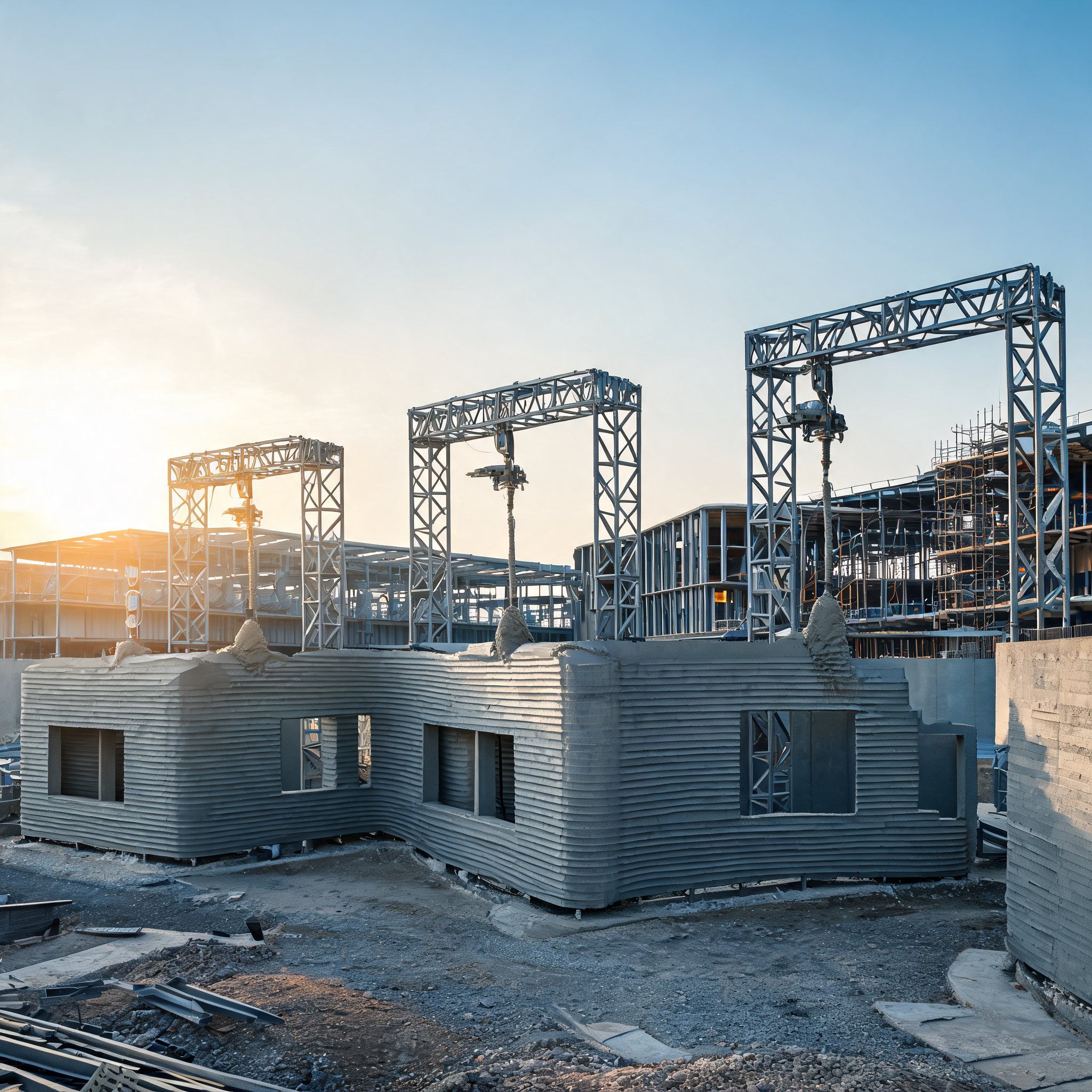
Florida-based construction 3D printer manufacturer AMTG has disclosed that three of its G2 gantry systems were deployed together to produce the printed wall system for the Mella shopping center. The commercial construction project, developed by an AMTG customer, used three synchronized printers in a coordinated workflow so that long wall sections, openings and architectural transitions could be formed directly during printing.
Distributing the work across the building footprint allowed the project team to avoid relying on a single machine. AMTG describes the G2 as a high-reach gantry construction 3D printer intended for large building projects, with a modular Cartesian structure that can be configured according to a building's geometry and site requirements.
Coordination details left undisclosed
The company has not disclosed how the three printers were synchronized, including whether they operated simultaneously under centralized control or followed coordinated production schedules. Even so, the project illustrates one approach to scaling construction 3D printing by deploying multiple gantry systems rather than a single unit.
AMTG's involvement was limited to supplying the printing systems, operator training and equipment-operation certification. Structural design, materials and construction remained the responsibility of the customer's qualified professionals.
Beyond the G2, AMTG offers three construction 3D printer families. The R-Series covers road-mobile and tracked robotic systems for rapid deployment, the G-Series comprises gantry printers for on-site construction, and the F-Series focuses on factory-controlled production of prefabricated components.
3D printing enters conventional construction
Construction companies are increasingly integrating 3D printing into commercial building projects. In the United States, Alquist announced an expansion of its construction 3D printing operations through a partnership involving Walmart, construction firm FMGI and equipment supplier Hugg & Hall. The initiative covers more than a dozen commercial projects and includes equipment deployment, operator training and technical support, reflecting a model in which contractors fold 3D printing into their existing construction operations.
A comparable approach has emerged in Germany, where construction group Matthäi established a dedicated 3D printing division after completing a two-storey office building. Using a COBOD BOD2 printer, the company produced the building's walls in approximately 105 hours, while foundations, floors and roofing were completed using conventional methods.
Pushing capacity and reach
Other projects are exploring ways to increase production capacity and expand the areas covered by automated equipment. In France, the ViliaSprint² development used a COBOD BOD2 printer to construct a three-storey, 12-apartment residential building, printing its walls and load-bearing structure in 34 days against an initial estimate of 50 days. The project partners are planning a larger development involving two printers operating simultaneously.
In Australia, construction technology company Luyten 3D introduced its ASCEND A27, a tower crane-mounted concrete 3D printer with a working radius of up to 45 meters. Unlike conventional gantry systems, the ASCEND is designed to cover larger construction footprints from a single installation point.