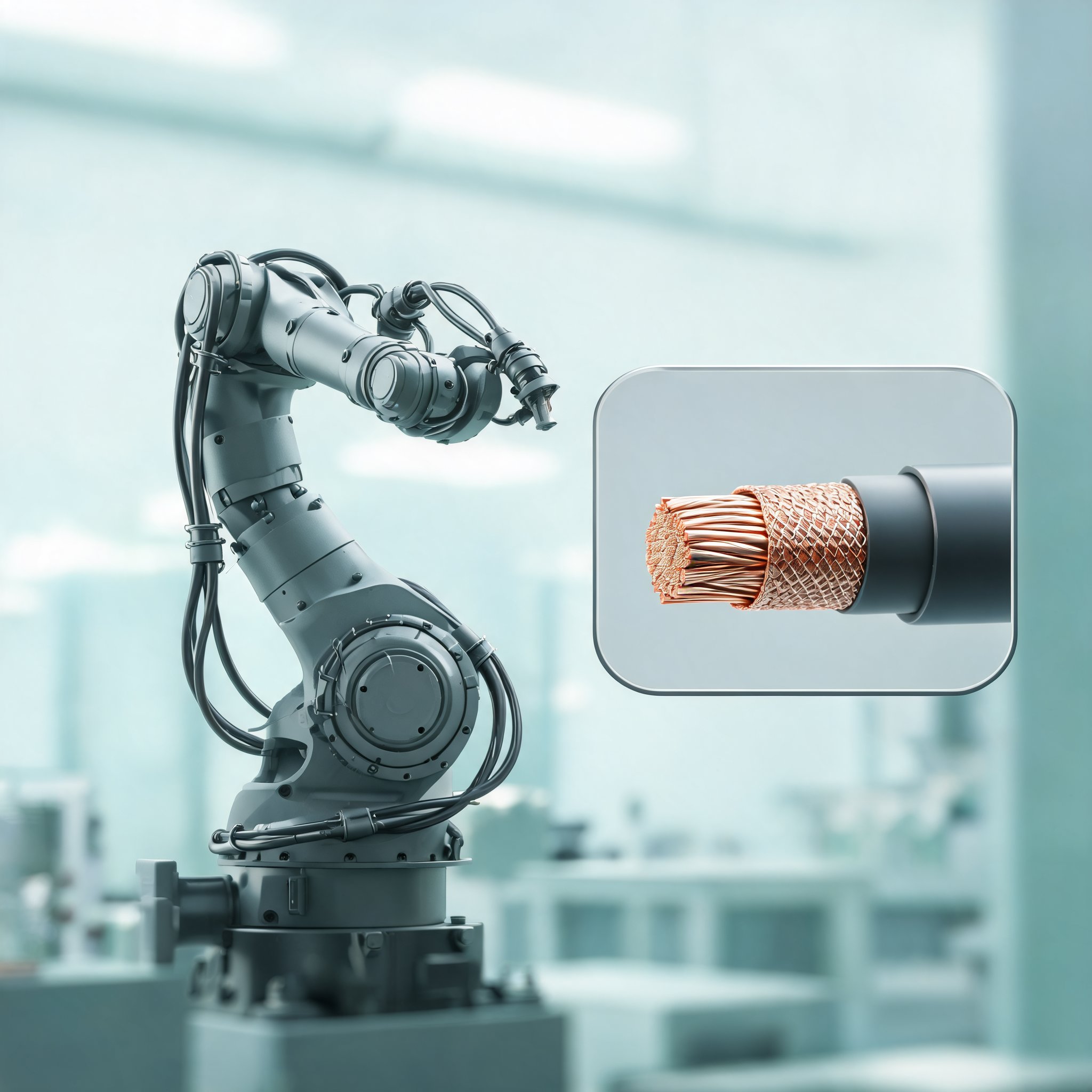
Igus has expanded its CFROBOT8.PLUS robot cable family with a new DeviceNet cable designed for dynamic robotic applications. In these installations the cable is twisted back and forth around its own axis rather than repeatedly flexed in a single plane, a duty cycle that works the shield, conductors and jacket each time the robot changes direction. Igus says the new cable is built to handle torsion of up to ±360° per metre, and that the CFROBOT8.PLUS family as a whole is engineered for up to 10 million torsional cycles.
The torsion figure is quoted per metre of cable, reflecting how much twist a given length is expected to absorb as a robot moves; the ± sign indicates that the movement reverses in both directions rather than accumulating in one direction only.
The family uses a specialised shield design that the company says provides flexibility during continuous robotic movement. The new DeviceNet version also has a reduced outer diameter — up to 21 percent smaller than previous CFROBOT8 models — which Igus presents as an advantage where cable runs have to pass through tight spaces.
Shield and environmental resistance
Conductors and braid must survive the reversing load, and Igus credits a tinned-copper braided shield with helping to maintain signal integrity under demanding conditions. Oil and UV resistance is said to allow reliable use in both indoor and outdoor environments.
Intended applications
Igus lists six-axis robots, handling systems, machine tools, linear and lead screw systems, and other applications with continuous torsional movement among the target uses for the new DeviceNet cable. The CFROBOT8.PLUS range extends beyond DeviceNet, with cables for PROFINET, PROFIBUS, CAN bus and Ethernet applications up to CAT7. The company says this breadth gives users options across a wide range of industrial communication systems.
Design balance
Cutting the outer diameter while retaining a braided shield sets two requirements against each other: a slimmer jacket leaves less material around the braid and conductors, and the shield still has to remain flexible enough to follow the robot. The announcement does not set out the construction changes behind the 21 percent reduction.
Test laboratory
Like all chainflex cables, CFROBOT8.PLUS products are tested in Igus's 5,500-square-metre laboratory under simulated real-world robotic motion. The company reports that testing has demonstrated reliable electrical performance through more than 15 million cycles.
Those figures are presented as Igus's own laboratory results for the cable family. The announcement does not give a separate cycle rating for the DeviceNet variant, and it does not list pricing, availability dates or electrical specifications such as temperature ranges.