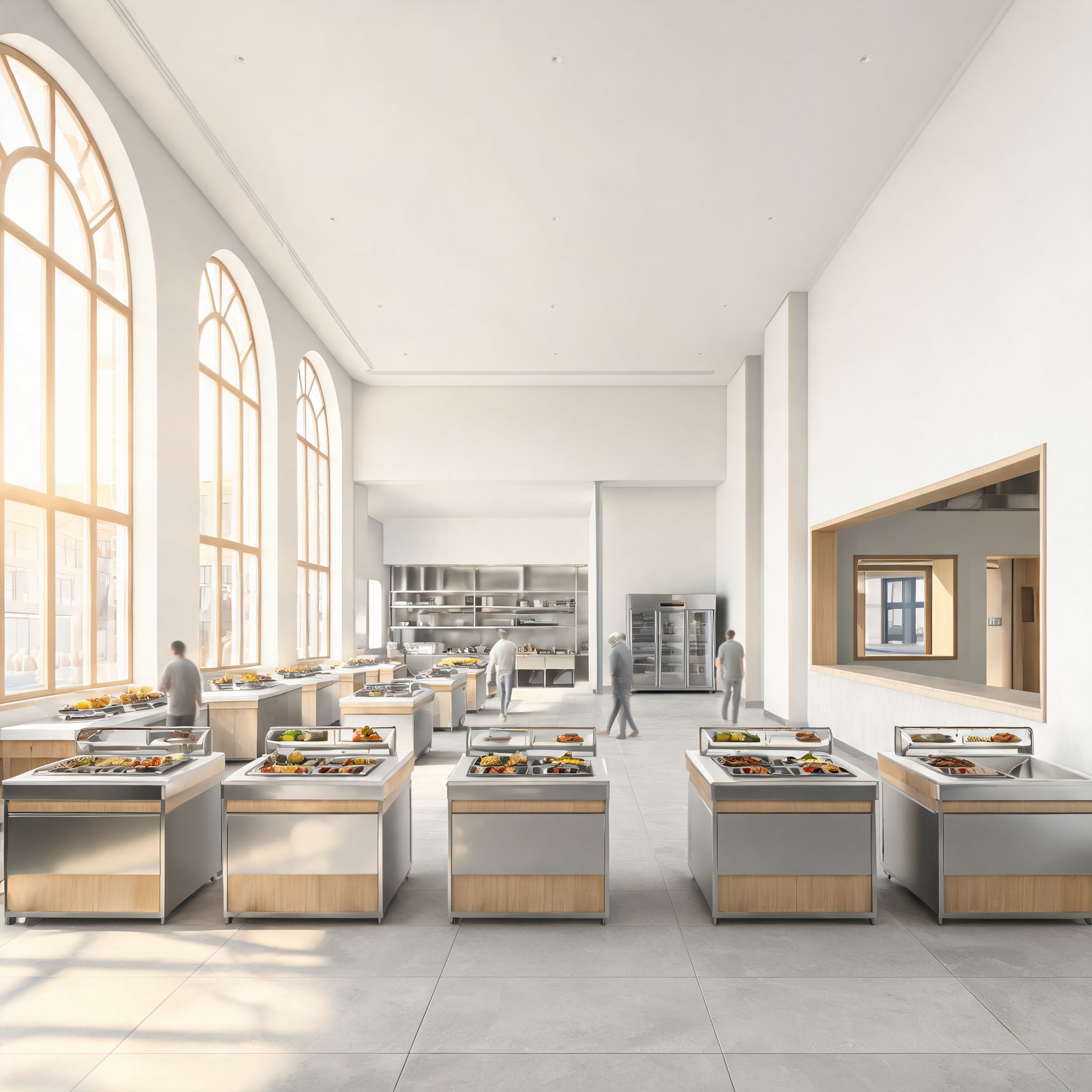
Texas Christian University’s BLUU Dining opened in August 2026 with a clear operational brief: create a destination for students and lift meal-plan participation as the Fort Worth campus grows. The facility, part of a $17 million overhaul of the Brown-Lupton University Union, is already producing evidence that the design is changing behavior. Less than two months after opening, BLUU Dining is averaging 4,000 meals a day, double the count recorded when the old Market Square closed for renovation in December 2025. Its peak day has reached about 5,700 meals, and Jude Kiah, associate vice chancellor for student affairs business and operations, estimates the operation could eventually produce 8,000 meals a day.
Those numbers matter because the project began with a diagnosis rather than a décor concept. Preliminary planning started in 2022 with surveys of student satisfaction with Market Square. Kiah said it took analysis across multiple surveys to establish that students disliked the facility, not the food. The old hall was perceived as a self-serve cafeteria offering premade food. Students, the research found, valued made-to-order food over speed of service and were willing to wait for customized meals. The team ran at least six surveys and focus groups before trusting the finding.
From research to a made-to-order platform
The resulting 13,000-square-foot dining hall, plus 4,500 square feet for platforms and back-of-house, is bright, open and airy, with 550 indoor seats and 120 patio seats. It has eight food platforms and a to-go window. The layout is not simply more generous than the old servery; it is organized around the behavior the surveys identified. Made-to-order production requires visible platforms, separate queues and enough back-of-house support to keep each station supplied. BLUU Dining’s design tries to resolve those requirements at once.
The relocation of the salad, deli and to-go platform is one example. Moving it away from the main servery gave the remaining platforms room and placed the station along a wall of windows overlooking campus. Kiah said it has become the most popular space in the facility, with students drawn to the light and the view of the stadium. The to-go window, called Dash, opens into the entrance hallway, so time-pressed guests can pick up a premade sandwich or salad without entering the servery. Kiah described it as a way to capture seats, add options and potentially operate late into the evening with little labor input. That is an operating opportunity rather than a proven result, but it follows directly from the building’s circulation.
Throughput depends on the back of house
Speed at the front is supported by changes behind the scenes. Miles Oller, director of facilities and operations, replaced the previous servery’s narrow passageway with a wide service hall that includes individual entrances to each platform. The aim is to remove competition for space. Oller said the real substance of the renovation lies in moving product from one point to another safely and efficiently. The front-of-house result is visible in queue times: Kiah recalled a bowl line 15 deep where the last person was served in four minutes and 30 seconds.
The support kitchen and walk-in cooler received a parallel overhaul. Replacing old tile flooring with epoxy required removing equipment, which led the team to examine 15-year-old pieces and undertake a one-for-one replacement of nearly everything in the support kitchen. A new 800-square-foot walk-in cooler allows pallets to be rolled directly inside, unloaded onto carts and sent where needed. That is a receiving and distribution change, not a cosmetic one. For a multi-platform hall, the cooler and service corridor determine whether eight stations can operate as one system.
Equipment chosen for uptime, not novelty
The equipment strategy reinforces the same logic. Planners weighed capacity, flexibility, maintenance needs and training needs. In the pizza area, the team chose an industrial rotating oven over a stone-hearth unit that the interior designers favored. The rotating oven can produce 116 pizzas an hour and bake casserettes on a lower level; one worker can load from the front while another unloads from the side, avoiding reach into a 550-degree oven. Other selections include a customer-facing soft-serve machine described as reliable, easy to operate and low in amperage draw; a round griddle that also serves as a plancha; and a pasta station that can switch to breakfast items.
In general, the team favored low-tech, durable equipment over computer-controlled units. Oller’s criterion was equipment that keeps working without requiring specialized expertise. The hardest units to replace were 30-year-old oven ranges still in use from the original makeover; a maintenance technician resisted their removal because they had never broken down. The new pieces came from the same supplier. Maintenance planning extended to brands: the team avoids a griddle brand and a warewasher brand that had caused repair difficulties, and its service company researched the cost of thermostats and other repair parts to estimate future maintenance and longevity.
Growth will test the model
BLUU Dining is part of a broader dining strategy. TCU opened East End, a dining hall on the opposite side of campus, in January 2025, and staff have revamped menus with Sodexo’s One & All college dining concept. Meal-plan enrollment stands at 6,300, with expectations of surpassing 8,000 in the coming year. TCU plans to add 2,500 beds on campus next fall. Kiah said the two dining facilities have helped bring the strategy together and that BLUU Dining needed “gravity” compared with East End; the early meal counts suggest it is acquiring that role.
The evidence is still early. The 4,000-meal average covers less than two months of operation, and the 8,000-meal figure is an operator estimate rather than a demonstrated sustained capacity. Meal counts also do not by themselves show financial performance, labor productivity or student satisfaction. What the project does show is how a university can link student research, front-of-house circulation, back-of-house logistics and equipment serviceability into one operating model. BLUU Dining’s next test will come as new housing adds demand. As Kiah put it, the facility is off to a good start; now the team has to operate it.